Residents parking permit rules: UK guide & common traps
Learn UK residents parking permit rules, including eligibility, visitor permits, controlled parking zones (CPZs), suspensions and PCNs—and how to appeal.

Kwame Asante
7 March 2026
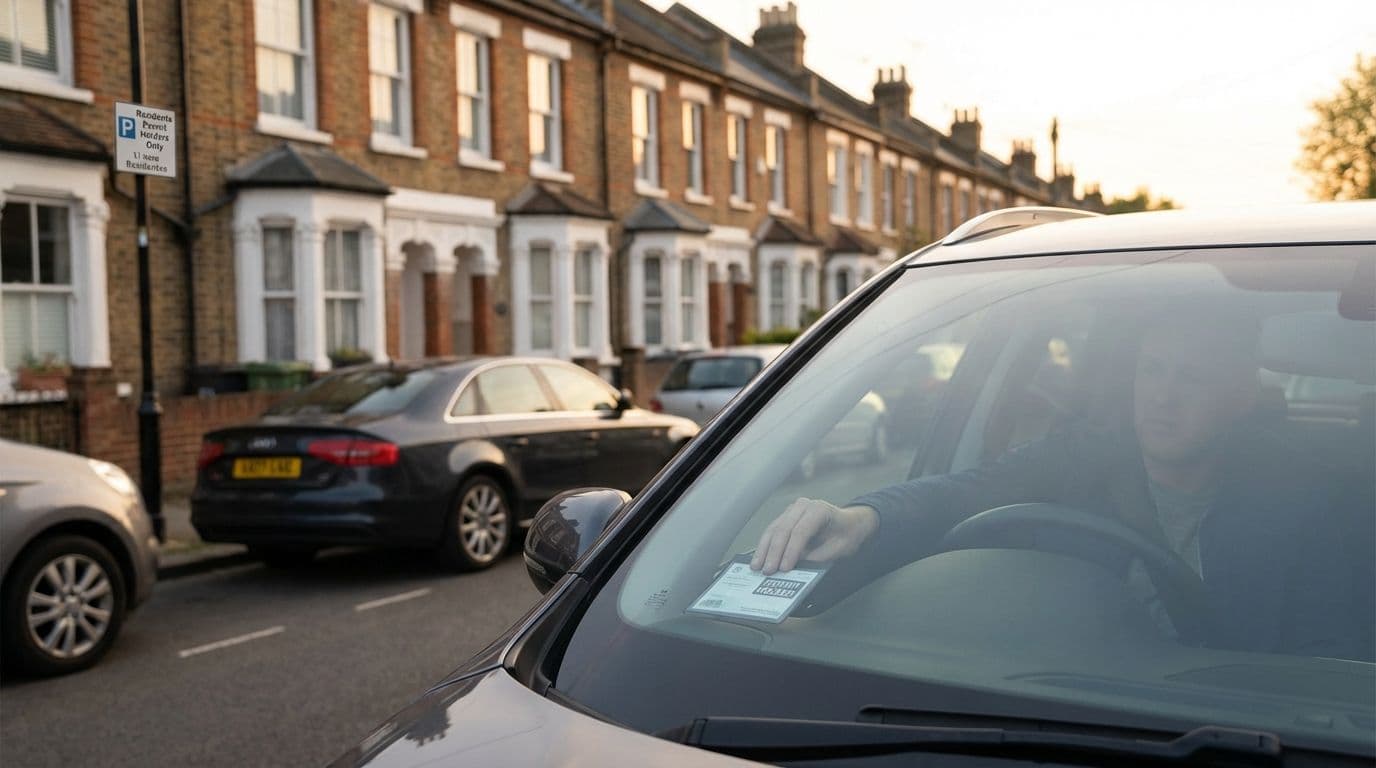
Residents Parking Permit Rules: The UK Guide That Could Save You a Fine
You've lived on the same street for three years. You know every neighbour, every pothole, and exactly which spot outside your house gets the most morning sun. Then one Tuesday morning, you walk out to find a bright yellow Penalty Charge Notice tucked under your wiper — despite your residents permit sitting clearly on the dashboard.
Sound familiar? You're not alone. Residents parking permit rules in the UK are riddled with nuances that catch even long-term permit holders off guard. Whether it's a suspended bay you didn't know about, a permit that quietly expired, or a visitor who parked half a metre outside the designated zone, the traps are everywhere.
This guide cuts through the confusion so you know exactly where you stand.
What Is a Residents Parking Permit, and Who Qualifies?
A residents parking permit is issued by your local council and allows you to park in designated permit holder bays within a Controlled Parking Zone (CPZ). CPZs are areas where parking is restricted during set hours — typically shown on signs at zone entry points and on individual bay markings.
Resident permit eligibility generally requires you to:
- Be registered at an address within the CPZ boundary
- Own or regularly use a vehicle registered to that address (or in some cases, registered elsewhere but used by the household)
- Not have off-street parking available (some councils apply this condition)
Each council sets its own rules. In Westminster, for example, permits are tied strictly to the zone — you can't use a Zone A permit in Zone B even if they're neighbouring streets. Bristol City Council issues permits by postcode sector, while Birmingham operates a more area-wide system. Always check your specific council's scheme before assuming your permit covers the street you're parked on.
Pro tip: Moving house? Your old permit becomes invalid the moment you change address, even if you're staying in the same CPZ. Apply for a new one immediately — councils don't offer a grace period for this.
The Hidden Rules Most Permit Holders Don't Know
Displaying Your Permit Correctly
This is where a surprising number of PCNs are issued. Councils don't just want to see a permit — they want to see it displayed correctly. That usually means:
- Placed on the dashboard or in the front windscreen, visible from outside
- Showing the correct side (some paper permits have front and back — the wrong side showing is enough for a ticket)
- Not obscured by a sat-nav, sun visor, or condensation
If you've switched to a newer vehicle and forgotten to transfer your permit, you're also at risk. Many councils now issue virtual permits linked to your vehicle registration plate, which removes the display issue entirely — but you must update your VRM with the council if you change cars.
Understanding CPZ Operating Hours
CPZ restrictions only apply during the hours shown on signs. Outside those hours, anyone can park. But here's the trap: some CPZs operate 24 hours a day, seven days a week — particularly in dense urban areas like central London boroughs. If you assume your street's restrictions are 8am–6pm Monday to Saturday, but they're actually 8am–8pm including Sundays, you'll find out the hard way.
Always check the bay markings and zone entry signs, not just what a neighbour tells you.
Visitor Parking Permits: What You Need to Know
Most councils within CPZs offer visitor parking permits alongside residents' permits. These come in several forms:
- Scratch-card style — you reveal the date and time before your visitor parks
- Virtual visitor permits — logged online or via an app, linked to the visitor's VRM
- Paper day permits — issued in a book, one per day
The rules around visitor permits are strict:
- You cannot use them for your own vehicles — councils do check, and it's considered fraudulent use
- They must be activated before parking begins, not after a warden has already visited
- They're non-transferable — a permit issued to your address cannot be used on a neighbouring street, even within the same CPZ
Pro tip: Some councils limit the number of visitor permit sessions per year — Islington, for instance, caps households at a set number of virtual visitor sessions. If you're having regular visitors, check your allowance before you run out.
Parking Permit Suspensions: The Trap Nobody Expects
One of the most frustrating — and legally valid — reasons for a PCN is parking in a suspended bay. Councils can temporarily suspend permit bays for:
- Road works or utility works
- Film and TV productions
- Removals or skips
- Special events
Under the Traffic Management Act 2004, councils must give adequate notice of a suspension — typically by placing physical signs on the bay at least 24 hours in advance. However, "adequate" is doing a lot of heavy lifting there. Signs are sometimes posted late, blown over, or genuinely easy to miss.
If you receive a PCN for parking in a suspended bay and you believe the notice was insufficient or improperly displayed, this is absolutely grounds for appeal. Take photographs of the bay and any (or absent) suspension signage immediately.
Got a PCN Despite Having a Valid Permit? Here's What to Do
Receiving a parking PCN for permit holders is more common than it should be. Here's a structured approach to challenging it:
Step 1: Informal Challenge
Within 14 days of the PCN being issued, you can pay at the 50% discounted rate — or submit an informal challenge to the council. You don't lose the discount option just by challenging informally; the clock pauses while they consider it.
In your informal challenge, include:
- A clear photo of your permit as displayed
- A photo of the bay and any relevant signage
- A brief, factual explanation of why the PCN was incorrectly issued
Keep it concise. One page is enough.
Step 2: Formal Representation
If the council rejects your informal challenge and issues a Notice to Owner, you have 28 days to make a formal representation. This is a more structured process — your grounds must fit specific legal categories, including:
- The penalty was not payable
- The vehicle had been sold before the contravention
- Procedural impropriety by the council
Formal representations are taken more seriously and must be responded to with a Notice of Rejection or acceptance.
Step 3: Independent Appeal
If your formal representation is rejected, you can appeal to an independent adjudicator — either PATAS (London), the Traffic Penalty Tribunal (England and Wales outside London), or SPSO (Scotland). These are free to use and the adjudicator is genuinely independent of the council.
Pro tip: Councils lose a significant proportion of appeals at adjudication. If you have a strong case — particularly around signage, permit display, or procedural errors — don't be put off by an initial rejection.
Common Scenarios and What They Mean for You
Scenario 1: Your permit expired last week and you forgot to renew. You get a PCN. Unfortunately, this one is hard to fight — the permit must be valid at the time of parking. Renew early, set a calendar reminder.
Scenario 2: Your visitor parks in your residents bay with a visitor permit, but the permit was activated 10 minutes after the warden photographed the car. The PCN may still stand — activation must happen before parking, not after.
Scenario 3: You park in what looks like your normal bay, but roadworks have temporarily suspended it. You didn't see the sign (or it wasn't there). Challenge immediately with photos — this is one of the strongest grounds for appeal.
Scenario 4: You've moved within the same CPZ but haven't updated your address with the council. Your old permit is technically invalid. Update your details as soon as you move.
Actionable Next Steps
- Check your permit's expiry date today — and set a renewal reminder at least two weeks before it lapses
- Photograph your permit as displayed whenever you park, especially in unfamiliar bays within your zone
- Read your CPZ entry signs carefully — note the operating hours and zone letter
- Know your visitor permit allowance and track usage if your council caps it
- If you get a PCN, photograph everything immediately: the PCN, the bay, the signage, your permit
- Challenge within 14 days to preserve your 50% discount option while your informal challenge is considered
Residents parking permits should make your life easier — and they do, when you understand the rules properly. The councils aren't always wrong when they issue fines, but they're not always right either. Know your rights, keep your documentation sharp, and don't pay a penny more than you have to.
Written by
Kwame Asante
Community Rights Advisor
Ready to Challenge Your Ticket?
Let our AI analyse your PCN and generate a professional appeal letter in minutes.
Start Free Appeal